✅ What you'll learn
- AI is a skill not a magic button
- Why AI confidence is the danger
- Using AI to ask better questions
- How golf and AI require the same mindset
💡 Perfect if you're thinking...
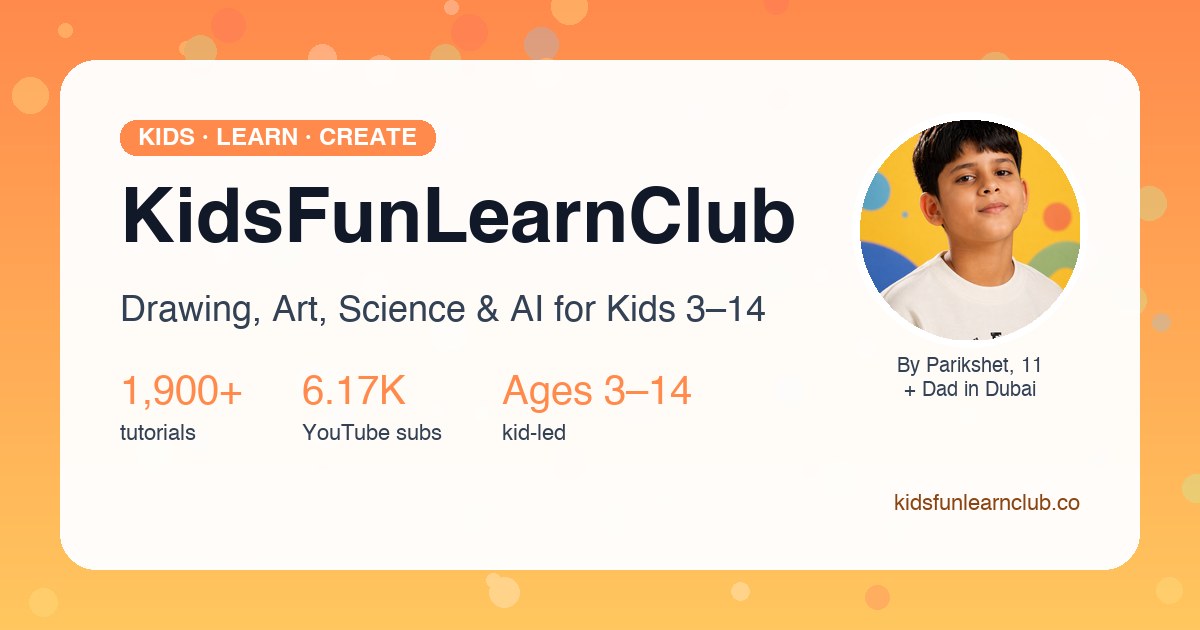
I'm Parikshet. I'm 11 years old, I live in Dubai, and I've been using AI tools seriously since I was nine — starting with the day I used an AI assistant to troubleshoot my PlayStation 5 when Fortnite wouldn't work in multiplayer. That was my first real use of AI as a problem-solving tool, and I've been experimenting with it consistently ever since.
After two years of daily use, completing the UAE's 1 Million Prompters certification, and building the AI for Kids curriculum at KidsFunLearnClub, here's what genuinely changed in how I think — and what I wish I'd known on day one.
1. AI Is a Skill, Not a Magic Button
When most people first use ChatGPT or Gemini, they treat it like a search engine with better writing: type a question, get an answer, done. That approach gets you maybe 30% of AI's actual value.
The people who get the most out of AI — and I've seen this in every context — treat it as a skill that requires practice. They've invested time in understanding what makes a good prompt, what kinds of questions AI handles well versus poorly, and how to iterate toward the answer they need. Getting good at AI is not different from getting good at golf: the fundamentals matter, and there's no shortcut around putting in the practice.
2. AI's Confidence Is the Danger, Not the Capability
The most important thing I've learned is not what AI can do — it's that AI sounds equally confident whether it's 100% correct or completely wrong. This is genuinely dangerous and most people underestimate it.
I've caught AI telling me incorrect Minecraft game mechanics with the same authoritative tone it uses for facts I've verified as correct. I've seen AI invent academic citations that don't exist. I've watched adults take AI output at face value and be embarrassed when someone pointed out the errors.
Two years of using AI has made me a better fact-checker of everything — not just AI output — because I've developed the habit of asking "how do I know this is true?" for anything that matters.
3. The Best AI Prompt Is One That Makes You Think
Early on, I used AI to get answers. Now I often use AI to get questions — to help me figure out what I don't know yet, what angles I haven't considered, what objections I haven't thought of.
For example: instead of "write me an essay about climate change," I now ask "what are the strongest arguments against the claim that renewable energy can fully replace fossil fuels by 2050?" That prompt makes me think. The answer gives me things to research and push back on. I learn more from that exchange than from any AI-written paragraph about climate change.
4. Golf and AI Taught Me the Same Thing
This might sound strange, but the skill that helped me most with AI was competitive golf. Golf is a sport where you have to be brutally honest about your current performance — you can't blame the club or the course. The score is the score.
AI requires the same honesty. When AI gives a bad answer, the instinct is to blame the AI. But usually, the prompt was unclear, the context was missing, or I was asking the wrong question. The discipline to look at your own role in a bad outcome — not just the tool's — is something golf taught me that I apply to AI every day.
5. What I Wish I'd Known on Day One
Stop treating AI as a search engine. Start treating it as a thinking partner — something to reason with, argue against, and test. Give it your situation, not just your question. Tell it what you already know and what you're trying to figure out. Ask it to challenge your assumptions. When it gives you something wrong, figure out exactly what was wrong and why.
The kids who will use AI best in five years are the ones practising that approach now, not the ones who've found the fastest way to get a passable answer and move on.
Frequently Asked Questions
How long has Parikshet been using AI?
Parikshet has been using AI tools seriously since age 9, starting with troubleshooting his PS5 in 2022. He completed the UAE 1 Million Prompters certification in 2025.
What is the most important AI skill according to Parikshet?
Fact-checking AI output — specifically, developing the habit of verifying anything that sounds important, because AI's confidence level tells you nothing about its accuracy.
What is the SUPER Prompt Formula?
Parikshet's framework for effective AI prompts: Specific, Unique (your situation), Precise (format), Example-based, Result-focused. Developed after two years of experimenting with what works.
Learn AI With Parikshet — Free Course
The full AI for Kids curriculum at KidsFunLearnClub.
Start Learning Free →📚 Sources & Further Reading
- Generative AI — Wikipedia
- Prompt engineering — Wikipedia
- UAE Office for AI
- Artificial intelligence — Britannica
Written by Parikshet More (KidsFunLearnClub, Dubai) and reviewed for accuracy. Facts checked against the references above.
🧠 Quick Quiz — Test What You Learned!
Created by Parikshet & Dad
Hi! I'm Parikshet, an 11-year-old creator from Dubai who loves drawing, art, science experiments, and golf. My dad and I run KidsFunLearnClub to share fun learning activities with kids around the world. We've created over 1,900 tutorials and videos to help you learn and have fun!
🎁 Free AI Activity Pack for Kids
20 hands-on AI activities Parikshet uses with his students — free, no credit card, instant download.
Get the Free Pack →Parikshet also teaches AI!
Join thousands of kids learning how AI works — in simple, fun lessons anyone can follow. Free activity pack included.
Explore AI for Kids → What is AI? Start here