✅ What you'll learn
- The educational research behind peer learning and near-peer teaching
- Why children learn differently from peers than from adults
- How Parikshet's age is a feature, not a limitation
- What near-peer teaching research shows about retention
💡 Perfect if you're thinking...
When parents first hear that the AI Adventures course is taught by an 11-year-old, the immediate question is: should I trust this? It's a fair question. Here's both the honest answer and the educational research behind why peer and near-peer teaching often outperforms adult instruction for specific types of learning.
What the research says about peer learning
Decades of educational research consistently shows that learning from peers — people at a similar age or level — produces strong outcomes, often matching or exceeding outcomes from expert-taught instruction for certain types of content. Key findings:
- Relatable explanations: Peers explain concepts at the level they themselves just understood them — which is often the exact level a learner needs, not the over-simplified version an expert produces when "dumbing it down"
- Reduced anxiety: Children are significantly less afraid of asking "stupid questions" to a peer than to an adult expert. Fear of embarrassment suppresses learning.
- Better retention: The "protégé effect" — teaching something to someone else forces the teacher to understand it deeply — means Parikshet's own AI understanding deepens by teaching it.
- Modelling the learning journey: Watching a peer figure something out is more motivating than watching an expert who already knows it. "If he can do it, so can I."
What Parikshet brings that no adult can
- Genuine discovery: When Parikshet explains that "AI sometimes gets hands wrong in images" — he found this out the same way his students will. His surprise was real. Adults teaching this concept are reciting a fact; Parikshet is sharing a genuine discovery.
- Kid-native examples: Parikshet doesn't reach for kid-friendly examples — he naturally uses Minecraft, YouTube, and the exact apps his students use, because he uses them too.
- No condescension: Expert adults often simplify too much or use language that inadvertently signals "this is the easy version for you." Parikshet explains things at his own understanding level — which happens to be the right level for his audience.
- Aspiration: Children watching an 11-year-old confidently explain machine learning and prompt engineering come away thinking "I could do that too" — not "AI is for adults and experts." That mindset shift is enormous.
What Sawan (Parikshet's dad) brings
Parikshet doesn't teach alone. His dad Sawan Kumar — a Chartered Accountant with deep expertise in AI and business — provides the pedagogical structure, accuracy review, and adult safeguarding that the course needs. The model is: Parikshet provides the peer connection and age-appropriate delivery; Sawan ensures accuracy and structure.
This combination — child relatability + adult rigour — is what makes the course work as both engaging content AND reliable education.
The honest limitations
Peer teaching isn't better at everything. For advanced technical content (Python programming, neural network architecture, complex maths) — adult expert instruction wins. AI Adventures is an AI literacy course, not an AI engineering course. For the content it covers — understanding AI concepts, using AI tools, thinking critically about AI — near-peer teaching is genuinely well-suited.
The bottom line
The question isn't "is Parikshet as qualified as a PhD AI researcher?" The question is "will my child learn AI concepts better from this course?" The evidence suggests yes — because of the peer dynamic, not in spite of it. And Parikshet's track record (6,000+ YouTube subscribers, 1,300+ educational videos, a growing global audience of kids who watch and learn from him) suggests the delivery works.
🚀 AI Adventures with Parikshet
Free hands-on AI activity pack — no credit card, instant download
Get the Free Pack →📚 Sources & Further Reading
Written by Parikshet More (KidsFunLearnClub, Dubai) and reviewed for accuracy. Facts checked against the references above.
🧠 Quick Quiz — Test What You Learned!
Created by Parikshet & Dad
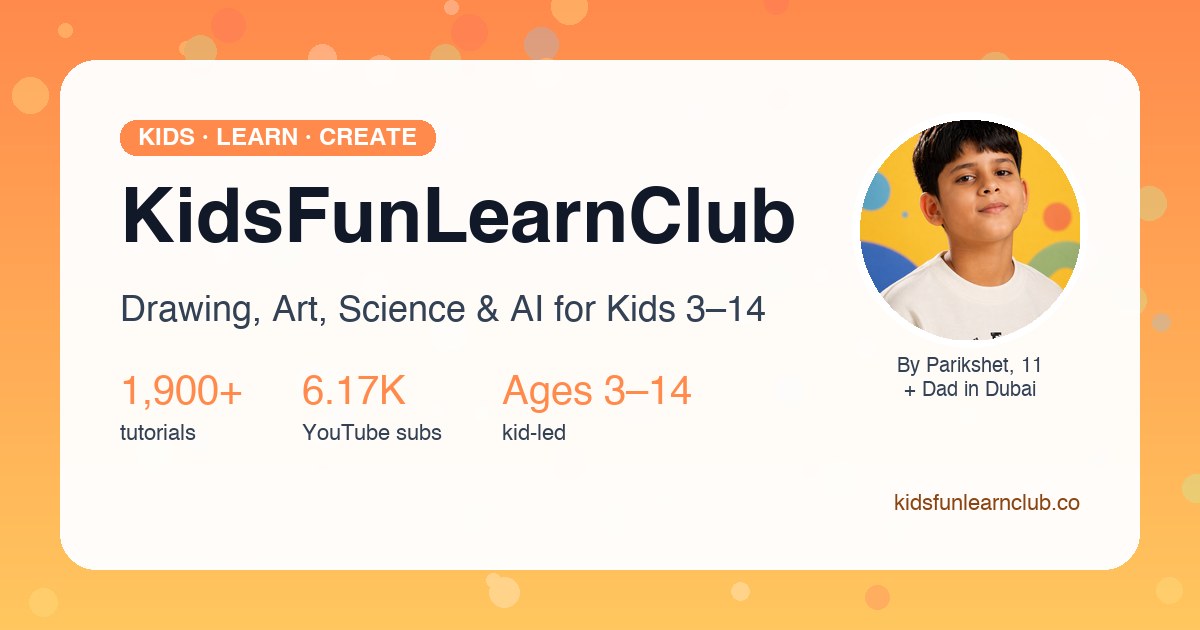
Hi! I'm Parikshet, an 11-year-old creator from Dubai who loves drawing, art, science experiments, and golf. My dad and I run KidsFunLearnClub to share fun learning activities with kids around the world. We've created over 1,900 tutorials and videos to help you learn and have fun!
🎁 Free AI Activity Pack for Kids
20 hands-on AI activities Parikshet uses with his students — free, no credit card, instant download.
Get the Free Pack →Parikshet also teaches AI!
Join thousands of kids learning how AI works — in simple, fun lessons anyone can follow. Free activity pack included.
Explore AI for Kids → What is AI? Start here