✅ What you'll learn
- KidsFunLearnClub's origin story
- How the AI curriculum was developed
- The father-son team behind the platform
- Who the platform is for
💡 Perfect if you're thinking...
KidsFunLearnClub didn't start as an AI education platform. It started as a YouTube channel where a little kid drew cartoon characters and did science experiments and occasionally beat his dad at chess. The AI part came later — because life, and a kid's curiosity, rarely go where you plan.
The Beginning: Drawing, Cooking, Science
The earliest KidsFunLearnClub videos are exactly what the name suggests: a kid having fun while learning. There's Parikshet drawing a snowman with careful, confident strokes. There's a cooking-without-fire episode where he makes a crunchy salad at age eight, narrating the steps with the seriousness of a Michelin-starred chef. There's a chess game against his dad — which he wins, by the way.
The channel was always about Parikshet teaching. Not adults teaching at kids, but a kid teaching kids — explaining things in the vocabulary and energy of someone who had just learned them and was immediately excited to share. That format worked. Kids responded to it differently than they responded to adult-presented educational content. They trusted the voice because it was their own.
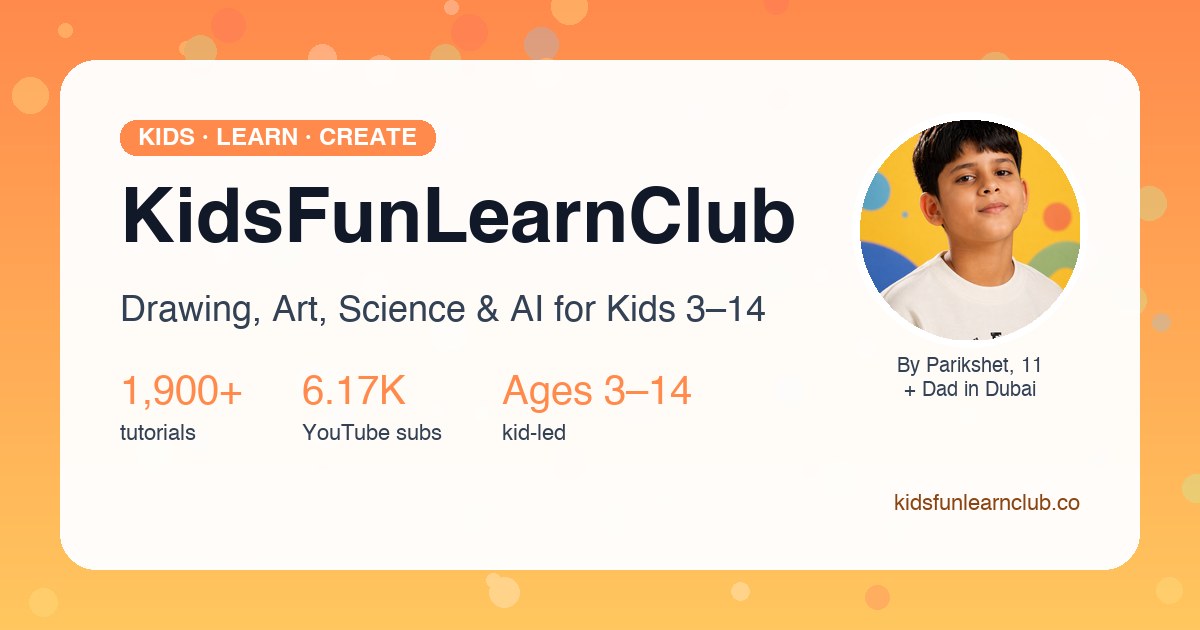
Over the years, KidsFunLearnClub accumulated more than 1,300 videos and 6,000 YouTube subscribers. It covered drawing tutorials, science experiments, Minecraft, Blockman Go, cooking, poems, golf, and stories. It was a genuine kid's world on screen, not a sanitised version created for educational packaging.
When AI Entered the Picture
Parikshet started experimenting with AI tools around age nine. His first real experience — the one that changed how we thought about what this channel could be — was using an AI assistant to troubleshoot his new PlayStation 5. He had a Fortnite multiplayer problem, a NAT type issue that was blocking online play. Rather than asking me, he methodically questioned an AI until he solved it himself.
After that, it kept happening. He'd use AI to plan a Minecraft strategy, then discover it had given him wrong information and learn to fact-check it. He'd use it for homework research and start noticing which kinds of questions it answered well and which it fumbled. He was building an intuitive model of AI's strengths and weaknesses before most adults had even tried ChatGPT once.
Around mid-2025, I started noticing something: his friends didn't know how to use AI at all. Their parents were trying to figure out whether to block it or allow it. Their school had unclear policies. Nobody was teaching these kids how to actually use this tool that was already embedded in their lives.
Parikshet could teach them. He had been figuring it out for two years already. He had the natural translator's gift — the ability to take a concept and find the exact analogy that makes it click for a specific audience. And he had the platform.
Building the AI for Kids Course
The AI for Kids curriculum at KidsFunLearnClub didn't come from a textbook. It came from Parikshet thinking through every concept himself and asking: "What's the simplest true explanation of this?" And then testing that explanation on actual kids — his friends, his cousins, classmates — and seeing where it got confused looks and where it got "oh, I get it now."
The neural network explanation that uses a baby learning to recognise cats: that came from a conversation where someone was struggling to understand how AI could learn. Parikshet said, "It's like a baby. At first they can't tell a cat from a dog. You show them lots of pictures and eventually they just know. The AI does the same thing with data." The room understood immediately.
The AI ethics lesson about bias: that came from a real discussion where Parikshet had noticed that some AI image generators made weird assumptions about what professionals look like. He found it interesting and a little troubling. We worked it into the course as a discussion, not a lecture — "here's what I noticed, here's what it means, here's what you should think about."
This is not standard educational content. It's one kid's genuine curiosity, systematised into lessons that other kids can follow and build on.
Dubai, Kolkata, and a Global Audience
We're based in Dubai. Parikshet is from a Kolkata family — he attended La Martiniere For Boys, one of the oldest schools in India. We live between two worlds: the high-speed tech culture of the UAE, where the government is actively investing in AI literacy for everyone, and the rich intellectual tradition of Kolkata, where Parikshet built his early foundation.
KidsFunLearnClub's audience is genuinely global. Kids from India, the UAE, the UK, the US, Southeast Asia — the universal language of a kid teaching clearly crosses every border. Parents message us from places we didn't expect. A mum in Malaysia telling us her daughter finally understood what AI was after watching Parikshet explain it. A dad in London saying his son had started experimenting with prompts after the SUPER Formula lesson.
That global reach is something we take seriously. It means the content has to be culturally neutral, accessible in varying English fluency levels, and genuinely useful rather than flashy. We don't spend our energy on production value. We spend it on clarity.
Where We're Going
In 2026, KidsFunLearnClub is expanding. The AI for Kids course is growing to cover AI in sports, medicine, music, environmental conservation, and daily technology. Parikshet is working on a project series — actual AI experiments kids can run at home without any coding experience. We're building the kind of resource we wish had existed when Parikshet first started figuring this out on his own at nine.
The goal has always been the same: kids who understand AI, don't fear it, know how to use it well, and know its limitations. That goal doesn't require expensive tools or impressive production. It requires a kid who genuinely knows the subject and genuinely cares about making it clear.
Parikshet is that kid. KidsFunLearnClub is the place. We're glad you're here.
— Sawan Kumar, co-founder, KidsFunLearnClub
Frequently Asked Questions
When did KidsFunLearnClub start?
KidsFunLearnClub started as a YouTube channel several years ago with drawing, science, and activity videos. The AI for Kids curriculum was added in 2025 when Parikshet began teaching the AI concepts he'd been learning independently.
Who runs KidsFunLearnClub?
Parikshet More (age 11) is the face and teaching voice. His dad Sawan Kumar handles the platform and operations. It's a genuine father-son project.
Is KidsFunLearnClub free?
Yes. The AI for Kids course and all content on KidsFunLearnClub is completely free. There are no paywalls or premium tiers for the educational content.
What ages is KidsFunLearnClub designed for?
The AI content is designed for ages 9–14. Earlier content (drawing, crafts, science experiments) is suitable for younger children aged 5–10.
Start the Free AI for Kids Course
100% free. Designed for ages 9–14. Taught by Parikshet — a kid who figured AI out himself.
Explore the Course →📚 Sources & Further Reading
Written by Parikshet More (KidsFunLearnClub, Dubai) and reviewed for accuracy. Facts checked against the references above.
🧠 Quick Quiz — Test What You Learned!
Created by Parikshet & Dad
Hi! I'm Parikshet, an 11-year-old creator from Dubai who loves drawing, art, science experiments, and golf. My dad and I run KidsFunLearnClub to share fun learning activities with kids around the world. We've created over 1,900 tutorials and videos to help you learn and have fun!
🎁 Free AI Activity Pack for Kids
20 hands-on AI activities Parikshet uses with his students — free, no credit card, instant download.
Get the Free Pack →Parikshet also teaches AI!
Join thousands of kids learning how AI works — in simple, fun lessons anyone can follow. Free activity pack included.
Explore AI for Kids → What is AI? Start here