✅ What you'll learn
- The science concept behind the experiment
- How to set it up safely
- What to observe and record
- Why the result happens
💡 Perfect if you're thinking...
Science Experiment with Parikshet Ep 04 | Walking Water | Fun with Science
Watch this fun and entertaining video from Kids Fun Learn Club!
The science behind it, made simple
Science is just a careful way of asking questions and looking for answers. When you wonder why the sky is blue, why ice melts, or why magnets stick, you are already thinking like a scientist.
The cool part about science is that anyone can do it, including kids. All you need is a question, a bit of patience, and the willingness to be wrong sometimes. Mistakes are how new ideas get discovered.
Real scientists test their ideas with experiments. They write down what they expect, try it out, and see what happens. If the result is different from what they thought, that is not a failure. It is a clue.
The more you learn about one part of science, the more you spot it everywhere. Cooking is chemistry. Sports are physics. Even brushing your teeth has a tiny science story behind it.
Fun facts to share at school
- Your body has around 37 trillion cells, all working together
- Honey never goes bad, even after thousands of years
- Bananas are slightly radioactive, but completely safe to eat
- A single bolt of lightning is five times hotter than the surface of the Sun
Try this at home
Pick one fact above and explain it to a grown up at dinner. Teaching someone else is one of the fastest ways to remember a science idea for good.
Frequently Asked Questions
Who makes these videos?
Kids Fun Learn Club is a channel run by a father-son duo making learning fun for kids worldwide!
Where can I find more videos?
Visit our YouTube channel Kids Fun Learn Club for hundreds more fun videos and tutorials!
You Might Also Like
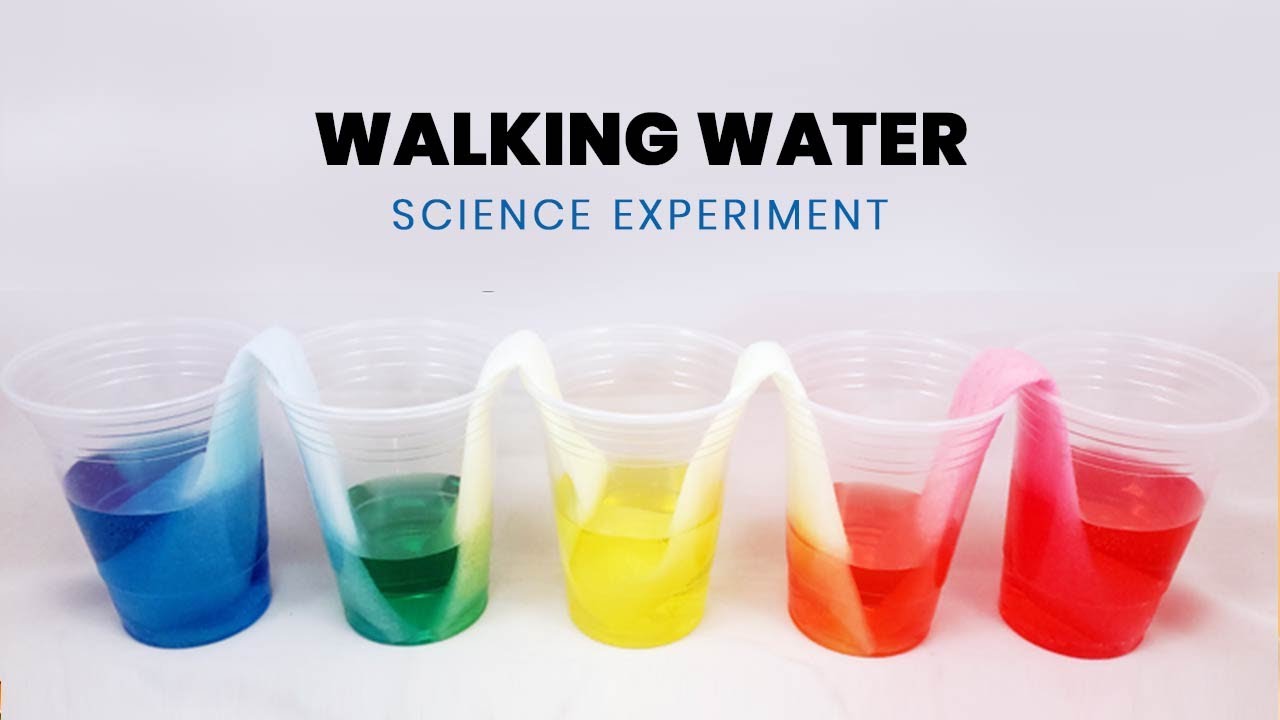
What Is the Walking Water Experiment?
The walking water experiment shows how water can travel upward against gravity through a paper towel — moving from one glass to another all by itself. It looks impossible, but it is pure science. You can even mix colours to create new ones as the water walks!
What You'll Need
- 6 clear glasses or cups
- Paper towels (the thicker the better)
- Water
- Red, blue, and yellow food colouring
Step-by-Step Instructions
- Set up 6 glasses in a circle, alternating between full and empty: full, empty, full, empty, full, empty.
- Add enough water to fill the three alternate glasses about halfway — leave the other three glasses completely empty.
- Add red food colouring to one full glass, yellow to the next, and blue to the last one. Stir each to mix the colour through.
- Cut or fold paper towels into strips. Bend each strip into a U-shape and place one end in a full coloured glass and the other end into the empty glass next to it.
- Repeat until every adjacent pair of glasses is connected by a paper towel bridge.
- Leave for 30 to 60 minutes and watch the magic. The water will travel from the full glasses up through the paper towel bridges and down into the empty glasses.
- Where colours meet in the empty middle glasses, they will mix to create secondary colours — red and yellow make orange, yellow and blue make green, red and blue make purple!
The Science Behind It
Paper towels are made of tiny cellulose fibres with microscopic gaps between them. Water is attracted to these fibres by a force called adhesion — the same attraction that makes water droplets cling to glass. Capillary action draws the water upward through those tiny gaps against the pull of gravity, and the water then flows down the other side into the empty glass.
Fun Facts About Capillary Action
- Capillary action is how trees move water from their roots all the way up to their highest leaves — sometimes 100 metres above the ground.
- Your own blood moves through tiny capillary blood vessels using a similar combination of pressure and adhesion.
- This experiment demonstrates primary colour mixing in a way that is both visual and lasting — the mixed colours stay in the glasses!
🧠 Quick Quiz — Test What You Learned!
Created by Parikshet & Dad
Hi! I'm Parikshet, an 11-year-old creator from Dubai who loves drawing, art, science experiments, and golf. My dad and I run KidsFunLearnClub to share fun learning activities with kids around the world. We've created over 1,900 tutorials and videos to help you learn and have fun!
🎁 Free AI Activity Pack for Kids
20 hands-on AI activities Parikshet uses with his students — free, no credit card, instant download.
Get the Free Pack →Parikshet also teaches AI!
Join thousands of kids learning how AI works — in simple, fun lessons anyone can follow. Free activity pack included.
Explore AI for Kids → What is AI? Start here